

What is the finding
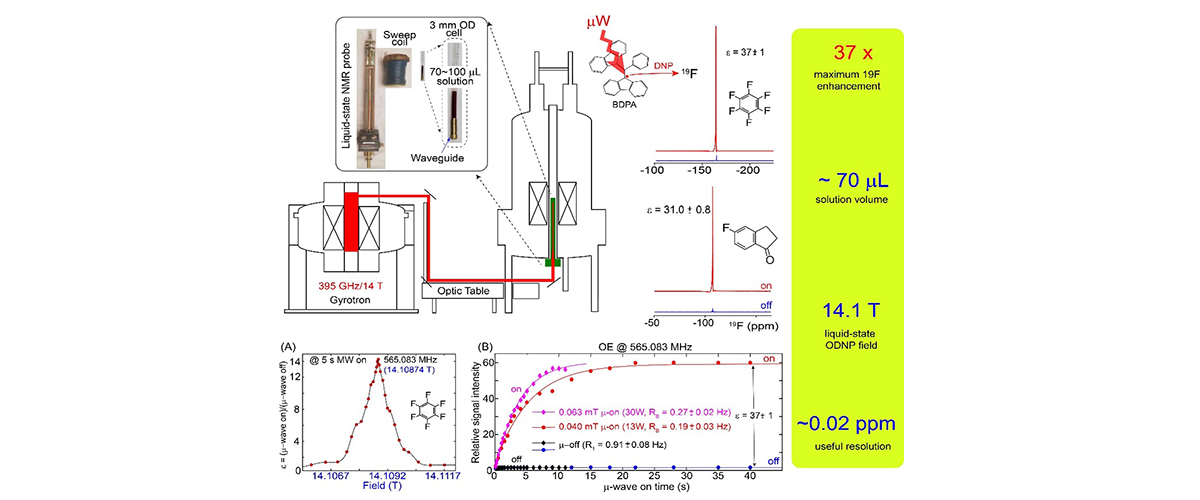
Researchers boosted fluorine-19 NMR signals of liquid samples by as much as 37 times at a high magnetic field. The measurements used about 70 microliters of solution, a practical volume for chemical analysis.
Why is this important?
Fluorine appears in many medicines, advanced materials, and persistent pollutants. Enhanced fluorine signals could help scientists to detect smaller sample amounts and/or concentrations, shorten measurement time, and distinguish different fluorine sites more clearly and precisely. It was found aromatic molecules received the largest boosts, while aliphatic molecules built up their enhanced signal faster (Fig.1). These differences show how molecular structure controls the process and point toward better ways to analyze fluorinated compounds, including per- and polyfluoroalkyl substances (PFAS).
Who did the research?
S. Wi1, J. Lumata1, T. Dubroca1, T. Orlando1, and L. Frydman1,2
1National MagLab; 2Weizmann Institute of Science
Why did they need the MagLab?
The result required the MagLab's rare combination of a 14.1 tesla NMR magnet, a 395 gigahertz high-power microwave source, and custom hardware that delivers microwaves to a liquid sample while precisely tuning the magnetic field.
Did you use any other national/user shared facilities?
This study was carried out solely utilizing Maglab’s NMR and EMR facilities in collaboration with researchers from the Weizmann Institute of Science in Israel.
Details for scientists
- View or download the expert-level Science Highlight, High-field liquid-state 19F Overhauser DNP reaches analytical sample volumes
- Read the full-length publication, 14.1 T Liquid-State 19F Overhauser Dynamic Nuclear Polarization in an Analytical Organic Setting., in J. Am. Chem. Soc.
Funding
This research was funded by the following grants: K. M. Amm (NSF DMR-2128556); S. Wi (NSF CHE-2203405); L. Frydman (Israel Science Foundation 1874/22)
For more information, contact Zhehong Gan.