

What is the finding
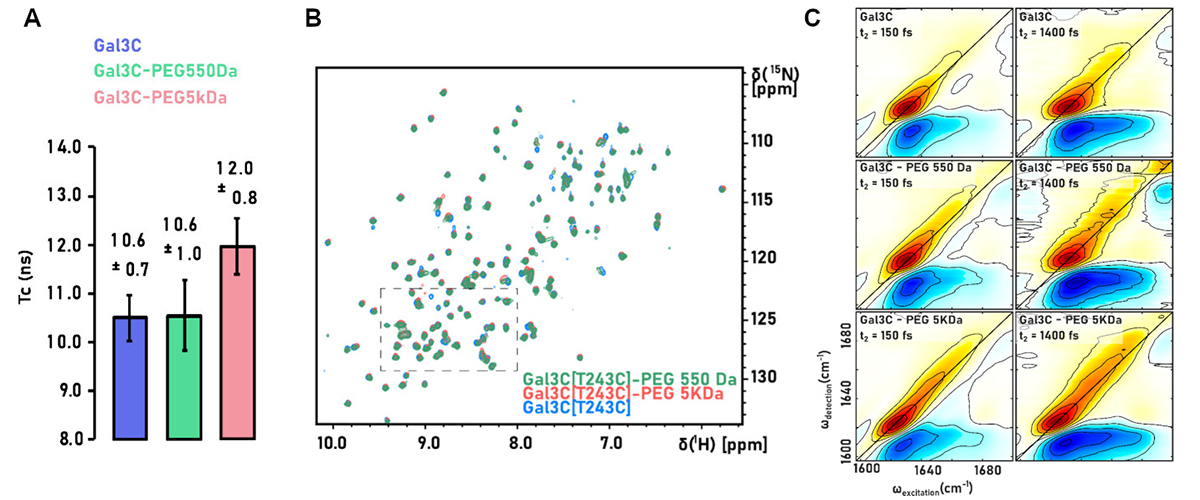
Researchers showed that PEGylation - attaching polyethylene glycol (PEG) chains to proteins - stabilizes proteins, not by removing water from their surface, but by reorganizing the surrounding layer of water molecules (known as the solvation shell). Using two-dimensional infrared spectroscopy, multidimensional NMR spectroscopy, and molecular dynamics simulations, the team found that longer PEG chains form a shroud-like coating around the protein and slow the movement of nearby solvent molecules. This altered solvent environment was directly associated with increased thermal stability, helping the protein maintain its structure under stress.
Why is this important?
PEGylation is one of the most widely used strategies for improving the stability and performance of biologic drugs, but its effects on protein behavior have often been unpredictable because the molecular basis of stabilization has remained unclear. By showing that longer PEG chains stabilize proteins through more extensive protein–polymer interactions and reorganization of the surrounding solvation shell, this work provides a mechanistic framework for understanding how polymer length influences thermal stability. These insights could help scientists design more reliable protein-based therapeutics and biotechnology products with improved performance and longer shelf life.
Who did the research?
Maia, R.1; Chen, X.1; Mulry, E.2; Eddy, M.T.2; Baiz, C.R.1
1University of Texas at Austin; 2University of Florida
Why did they need the MagLab?
The research relied on advanced NMR spectroscopy measurements conducted at the MagLab's AMRIS facility. The MagLab's high-performance NMR capabilities provided critical atomic- and molecular-scale information about the PEGylated proteins and enabled researchers to observe subtle structural and dynamic changes that would be difficult to detect with other techniques.
Details for scientists
- View or download the expert-level Science Highlight, Mechanism of Protein Stabilization by PEGylation
- Read the full-length publication, Solvent Reorganization in Stabilized Protein–Polymer Conjugates Visualized by Two-Dimensional Infrared and Nuclear Magnetic Resonance Spectroscopy, in JACS Au
Funding
This research was funded by the following grants: K. M. Amm (NSF DMR-2128556); C. R. Baiz (NIH R35GM133359, Welch Foundation F-1891); M. T. Eddy (NSF CAREER 2339330 )
For more information, contact Joanna Long.