

Contact: Ross McDonald
TALLAHASSEE, Fla. — The National High Magnetic Field Laboratory’s most powerful piece of equipment will soon be back online and enabling research at extremely high magnetic fields.
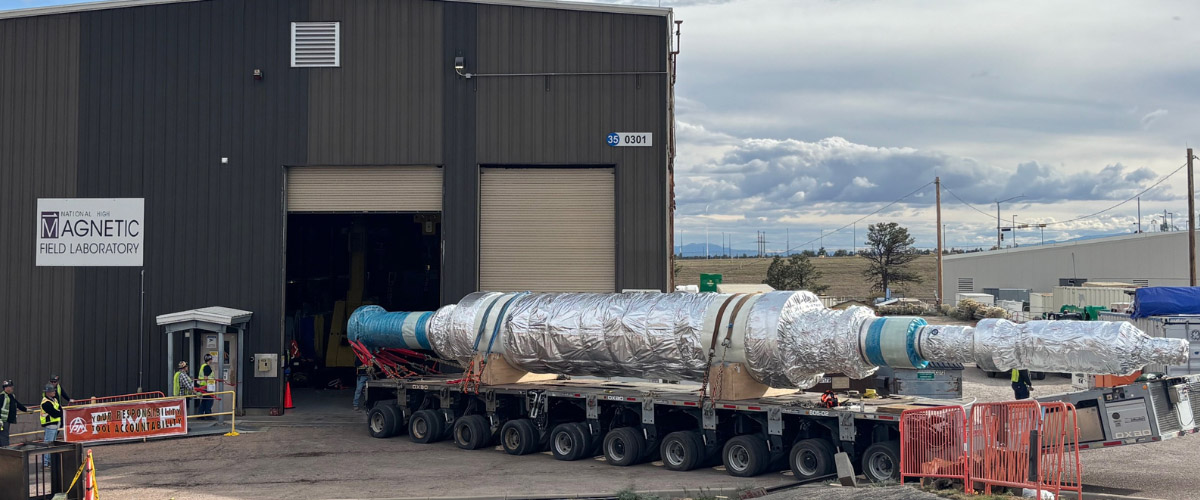
The 450-ton generator at the MagLab’s Pulsed Field Facility at Los Alamos National Laboratory has its giant rotor back in place. The generator, among the largest single power generation units in the U.S., can produce bursts of up to 1.4 billion watts of power, operating the Pulsed Field Facility’s strongest magnet, reaching a world-record 100 tesla.
"This capability is essential to the Lab's evolving missions in both fundamental science and national security," said MagLab Pulsed Field Facility Director Ross McDonald. "The rotor enables researchers to probe exotic states of matter, test materials under extreme conditions and conduct experiments critical to understanding physics and developing next-generation technologies that cannot be performed anywhere else in the nation."
Journey Around the World
It’s been an enormous undertaking to replace the massive rotor, which is the length of a tractor trailer at 63 feet and weighs about as much as the Statue of Liberty -- nearly half a million pounds.
The original rotor went down in April 2019 after 28 years of service. Engineers considered fixing it before realizing it was beyond repair. So, work began to forge a new rotor, maintaining the same fit, form and function but incorporating the latest power industry advancements.
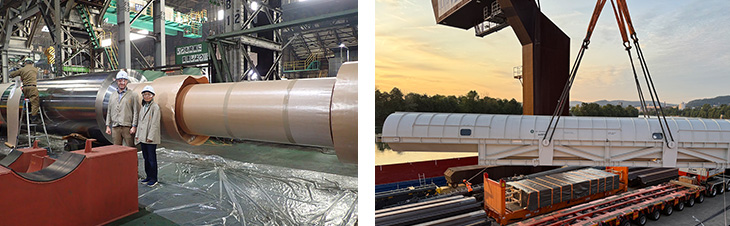
The rotor after its forging at Japan Steel Works (left) and being loaded on a barge in Switzerland (right).
The new piece, made of steel, copper, brass, and other materials, was forged at Japan Steel Works in Muroran, Japan. Then, the giant rotor was shipped from Japan to a GE facility in Birr, Switzerland for final machining, assembly, and precision balancing. After Switzerland, the rotor traveled by barge to the coast, then across the Atlantic Ocean to Houston, Texas before the final leg of its journey by ground from Texas to Los Alamos.
That’s seven years, three continents, and more than 12,000 miles to restore the Pulsed Field Facility’s full operational capabilities.

A look at the rotor’s long journey from forging in Japan and finishing in Europe to arrival at Los Alamos.
“The return of the rotor to Los Alamos is a milestone for the Laboratory and for the mission-relevant, foundational research we are excited to again undertake,” said Pat Fitch, deputy Los Alamos National Laboratory director for Science, Technology and Engineering. “This equipment provides record-setting capabilities that are useful across multiple areas of research. Our team and vendor partners have worked tirelessly to make this happen, and we’re proud to see their efforts pay off with the rotor’s return.”
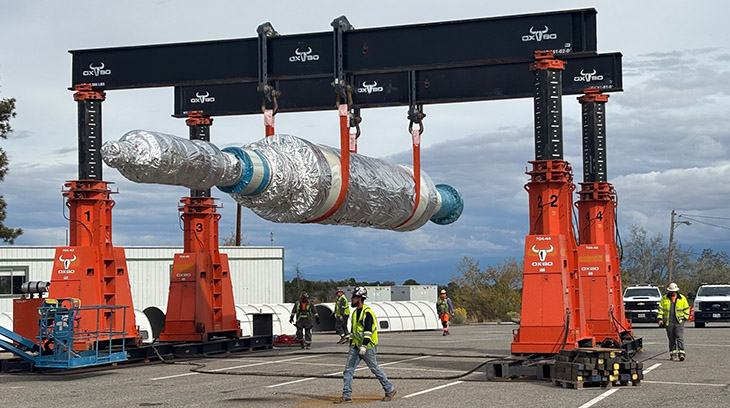
The final leg of the trip from Houston to Los Alamos was carried out on a suspension beam transport system. The heavy-duty vehicle is more than a football field long, includes up to five powerful tractors capable of hauling extremely massive objects, and has 226 tires to bear the tremendous weight.
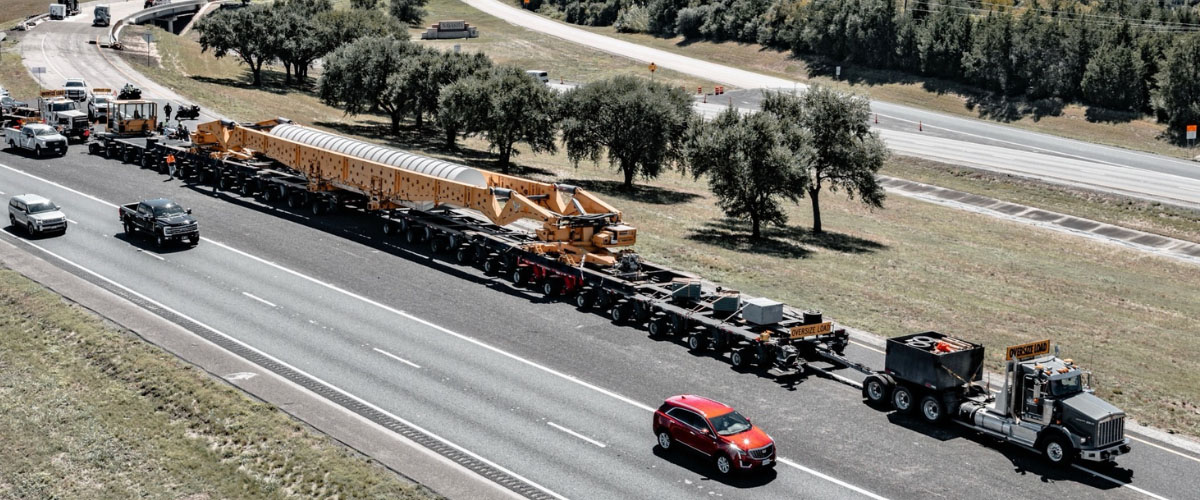
The rotor carried aboard a suspension beam transport system on the final leg of its journey to Los Alamos.
Photo Credit: Ox Bo Mega Transport Solutions
At the lab, the rotor was transferred to another specialized vehicle, called a self-propelled modular transport. The remote-controlled equipment has 20 sets of individually powered and controlled wheels that were used to maneuver the rotor into its building and into the generator housing.
Bearings will be reassembled around the rotor over the next few months with recommissioning of the generator planned for 2027.
The rotor awaiting installation after its arrival at Los Alamos.
Power of Pulsed Field Research
The pulsed field generator is so massive and powerful, it cannot sit directly on the ground, but rests on a system of giant springs with an empty basement floor below. The springs help absorb the powerful vibrations produced when the generator operates, keeping it from destroying its foundation when pulses of power are delivered to the magnets.
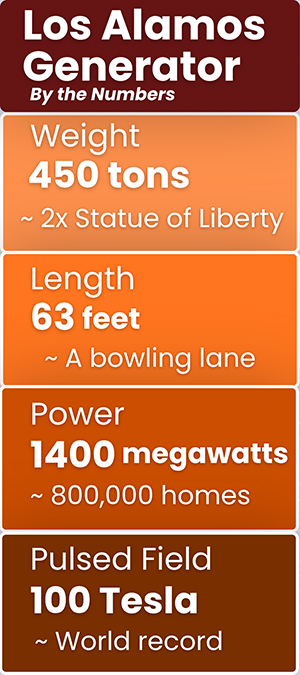
The generator’s tremendous power output allows the unique experimental capabilities at the MagLab’s Pulsed Field Facility with its user program supported by the U.S. National Science Foundation. Every year, approximately 150 visiting researchers come to use the one-of-a-kind instruments with the support of highly experienced staff scientists and technicians. Pulsed magnets available for researchers from around the world include multiple 60 and 65 tesla magnets, a 75 and 85 tesla duplex magnet and a 100-tesla magnet, the most powerful non-destructive magnet in the world. This fleet provides condensed matter physicists and materials engineers with cutting-edge research environments they cannot find anywhere else.
All photos except where otherwise noted are courtesy of Los Alamos National Laboratory. Los Alamos National Laboratory is funded by the U.S. Department of Energy.
The National MagLab is funded by the U.S. National Science Foundation.